
Making scheduling requests more flexible and connected.
Designing a smarter way for healthcare workers to request shifts—and for Schedule Managers to review approvals, maintain coverage, and reduce manual work.
View Figma Prototype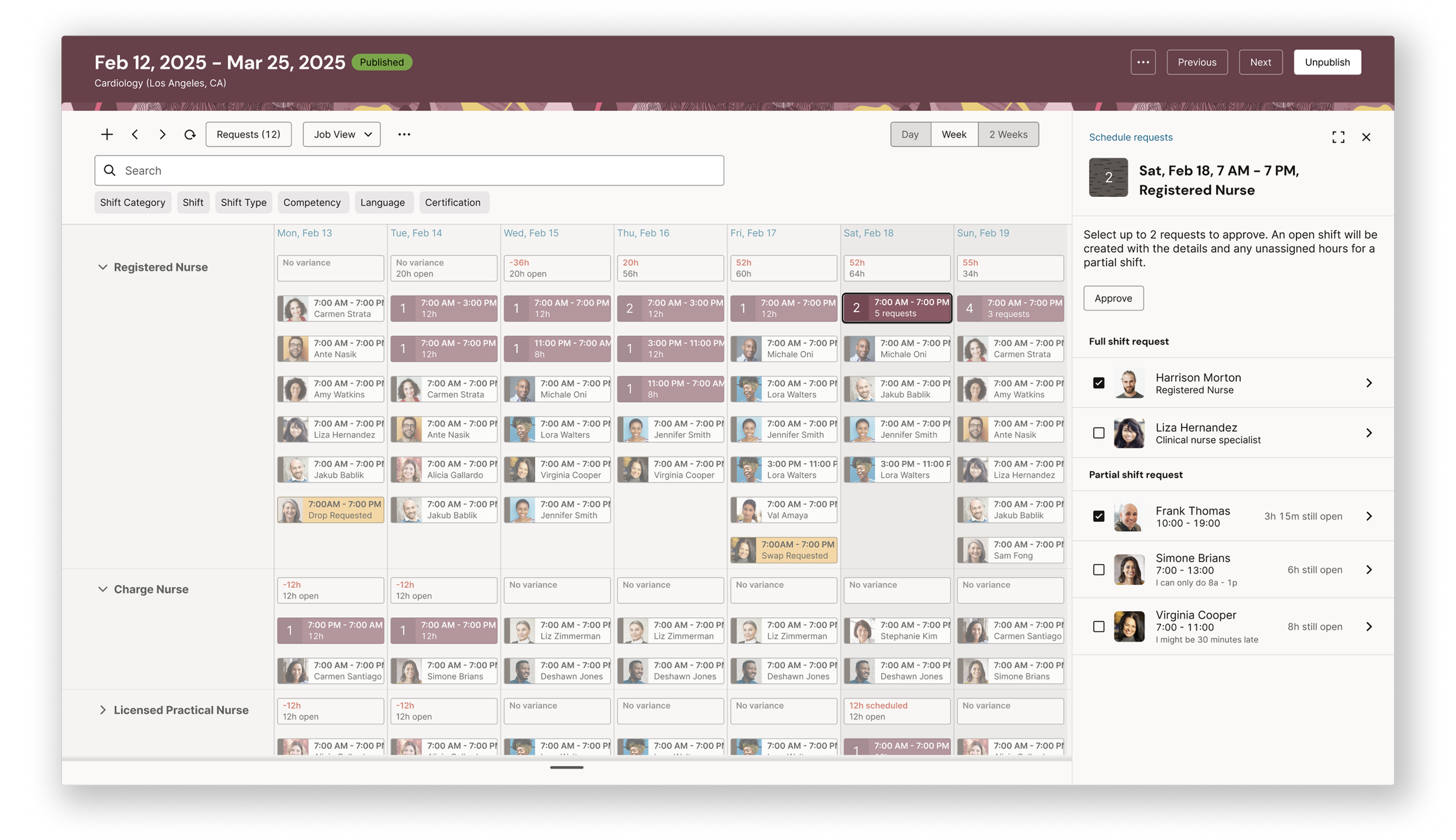
Making scheduling more adaptable, without adding complexity.
Workforce Scheduling is a multi-year initiative to simplify complex scheduling workflows. A key feature supports requests to claim open shifts, cover shifts, swap assignments, and drop shifts while accounting for staffing needs and scheduling rules.
For this next phase, I focused on enabling partial-shift flexibility and creating a cohesive approvals experience across Workforce Scheduling and a separate legacy product.
Connecting workflows across product boundaries
I partnered with designers and engineers to create a more integrated scheduling and approvals experience, balancing user needs with legacy platform limitations.
A few available hours shouldn't mean extra work for everyone.
Sometimes a nurse can cover only part of an open shift. That partial availability still helps close staffing gaps—but accommodating it required Schedule Managers to assign the shift, manually edit its hours, and recreate the remaining open hours.
Approvals also lived in a separate product, adding friction to request reviews and making the overall experience feel disconnected.
Enable flexible, partial-shift requests while maintaining staffing coverage and reducing manual scheduling work?
Flexibility for workers. Confidence for managers.
Maintain coverage with less effort
Allow workers to claim or swap partial shifts while ensuring the remaining hours are accounted for to meet patient care demand.
Find shifts that fit real availability
Request full or partial shifts that fit availability, providing more opportunities to contribute to staffing coverage.

Small scheduling decisions have a bigger impact.
Partial availability still matters
Even a few hours of availability can help close a staffing gap.
Manual adjustments add friction
Editing assignments and recreating open hours increases administrative effort.
Managers need scheduling context
Request decisions should account for remaining coverage and eligibility.
Approvals should feel connected
Moving between separate products interrupts the scheduling workflow.
Designing for flexibility and continuity.
Support requests that match worker availability
Explored ways for workers to request portions of shifts while helping managers account for remaining uncovered hours.
Bring request decisions closer to the schedule
Explored surfacing request details and approval actions within Workforce Scheduling so managers could review decisions with relevant schedule context.
Bridge Redwood and legacy ADF
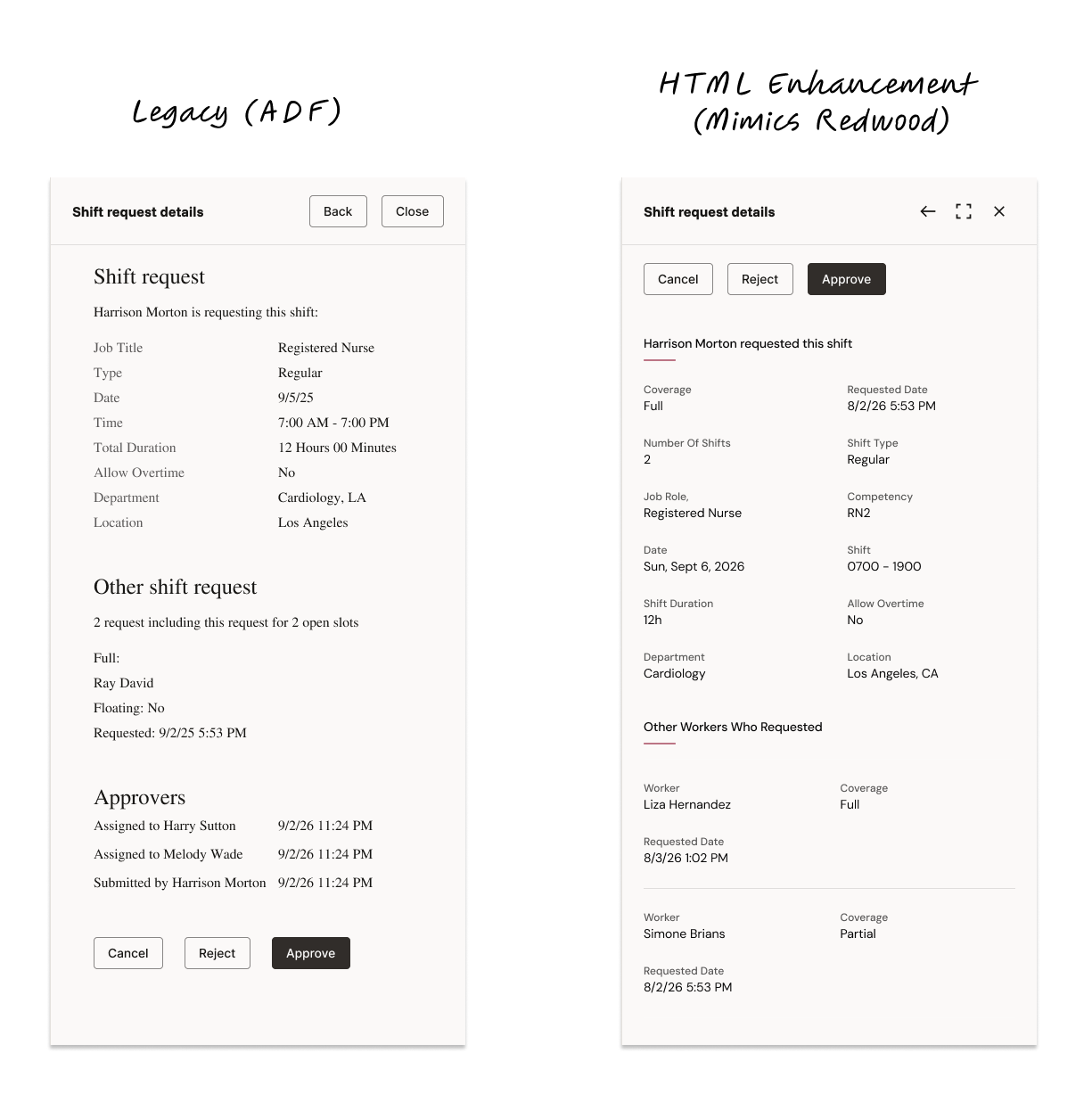
Worked with engineering and design partners to refine HTML-based approval content, improving hierarchy, spacing, and visual consistency within platform constraints.
Finding a path forward within platform constraints.
Two products. Two design systems.
While Workforce Scheduling used Redwood, Approvals relied on the legacy ADF framework and had no near-term migration plan. Available presentation options were largely limited to HTML, leaving the initial experience feeling visually disconnected.
I collaborated with engineering and design partners to identify feasible styling improvements that brought the approvals experience closer to Redwood without requiring a full platform migration.
Balancing flexibility with staffing coverage.
Partial shift requests helped workers contribute when they couldn't take an entire shift, but created downstream work to manage uncovered hours.
I considered the complete workflow—from a worker's request through the manager's decision and the resulting schedule—rather than treating approval as an isolated interaction.
A more connected scheduling experience.
The design aimed to reduce context switching, make partial coverage easier to manage, and create greater visual consistency across products.
More connected
Review scheduling requests closer to the schedule itself.
More flexible
Support partial availability rather than all-or-nothing shift coverage.
More cohesive
Bridge the visual gap between Redwood and legacy Approvals.
Great experiences shouldn't stop at product boundaries.
This project reminded me that creating a seamless experience requires more than consistent screens. It means connecting workflows, understanding downstream scheduling consequences, and finding thoughtful solutions within technical constraints.
What I took away
Collaboration and pragmatic design decisions can bridge legacy technology and modern user expectations—without losing sight of the people doing the work.